
Thin Air, Don’t Care: How to Spend Three Awe-Inspiring Days in Lhasa, Tibet

Sitting at a lofty 12,000ft, the Tibetan capital of Lhasa isn’t the easiest place to visit. But it’s totally worth the bureaucratic effort.
I first visited Tibet more than 10 years ago on a 30-day trip around the Himalayas,
And let me tell you, it wasn’t easy.
In fact, the week before I departed the United States, I’d all but lost hope for my visit to Tibet.
My entry permit fell through at the last minute necessitating a re-booking of flights and a complete revamp of my itinerary.
Note: This post may contain affiliate links. If you choose to book through these links, I receive a small commission, which I will undoubtedly blow on more flights (it’s a vicious cycle). All of this internet voodoo takes place at no additional cost to you.
But I was determined to find a way to visit Tibet while in the Himalayas. And after significant research, I located a travel agency – Tibet Vista – that saved the day.
They arranged for the required permit and guide and after some major itinerary shuffling, I made it to Tibet. And it was one of the most incredible places I’ve ever visited (worthy a spot on every Travel Bucket List).
I’ll get to the full story of my visit in a moment. But first, here’s the reason I decided to update and share this post again.
Recently, the nice folks at Tibet Vista reached out to me with the most current information on visiting Tibet.
The situation has relaxed quite a bit since my visit. So an update was in order to highlight this unique and once-in-a-lifetime travel destination.
Now, let’s rejoin my 30-day Himalayan trip as it happened and I’ll incorporate the latest Tibet info as we go…
Getting the entry permit
After a few days of R&R on the beach in Khao Lak, Thailand, I flew back to Bangkok. From here, I have a brief connection in Kunming, China on my way to Lhasa, Tibet.
Since a Tibet entry permit cannot be delivered outside of China, I will need to locate the travel agency representative in Kunming airport to obtain my permit. Only then am I allowed to check in for the continuing flight to Lhasa.
I definitely lost some sleep over all the things that could go wrong with this plan but, amazingly, it all goes according to plan. As soon as I exit customs, I spot the company representative waiting for me holding a sign with my name on it.
Hooray! I am really going to Tibet!
I didn’t actually believe it until I had that permit in my hands.
Tip: If you want the full process for visiting Tibet legally, skip to the end of this post. (But don’t do that, you’ll miss all the good stuff!)

Arrival in Lhasa
After a quick and scenic flight to Lhasa, I land on the Tibetan plateau known as the “Roof of the World.”
The city of Lhasa sits at a lofty 12,000ft. I’m worried that might be difficult for me since I’ve spent much of the past two weeks cavorting at sea level.
We’ll soon find out.
The first time I experienced high altitude was at Machu Picchu on Round-the-World #2. I did fine there, but that was only 7,900ft.
Earlier on this 30-day trip around the Himalayas, I hiked to the Tiger’s Next Monastery in Bhutan. At 10,000ft, that was a serious challenge. Luckily, I don’t have anything nearly as athletic planned for my two days in Lhasa.
I’m greeted by my guide for the next 3 days, Tenzin, and I’m pleased to discover that his English is excellent – you’d be surprised what passes for an “English-speaking-guide” in some places.
As I settle into the back of the SUV for the hour-long ride into Lhasa, Tenzin begins to tell me about the local culture and the landscape we’re passing through.
The Rules for Visiting Tibet
He also fills me in on some of the Do’s and Don’ts of visiting Tibet.
For example:
Do: Drink lots of water to combat the extreme altitude.
Don’t: Take pictures of any military or police activity (this is harder than it sounds because this sort of activity is literally everywhere).
This last one, Tenzin cautions, is extremely serious.
Even if you think you are being subtle about taking a photo from the car, there are cameras everywhere. They will record the car’s license number and they will know who you are and who your guide is.
All of this information is diligently recorded with your entry permit and there are serious repercussions for breaking the rules.
For this reason, it’s important to always err on the side of caution when it comes to photography and video within Tibet. (Both for your protection and for your guide’s.)
The St Regis Lhasa Resort
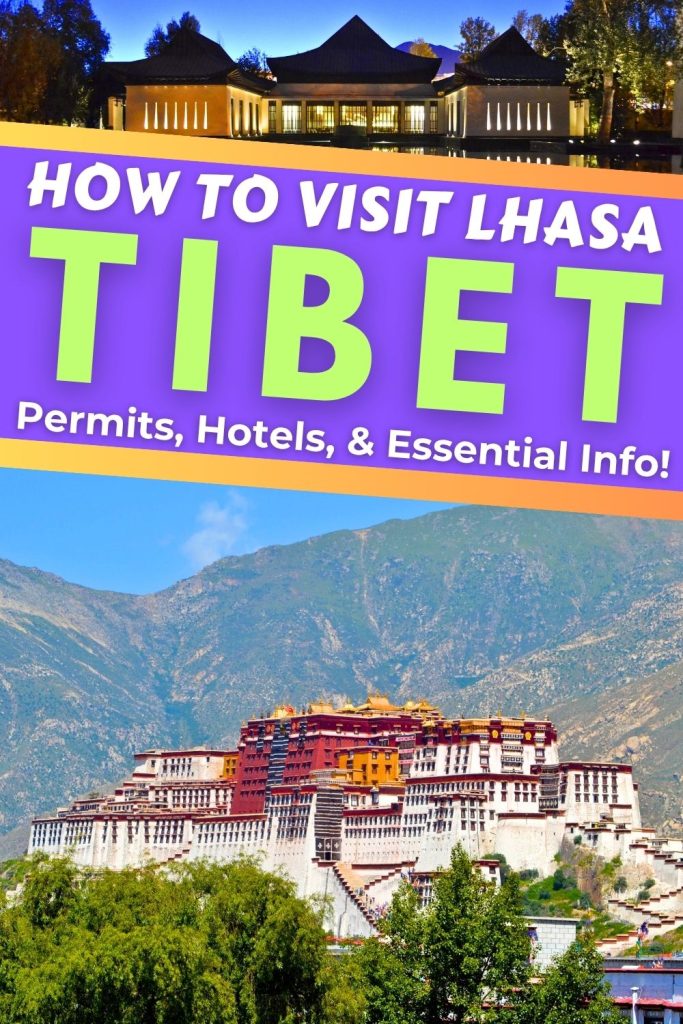
We arrive at the stunning St. Regis Lhasa Resort and I’m shown to the beautiful suite that will be mine for the next two nights.
It seems like the perfect place to combat altitude sickness and luckily there are oxygen canisters in the mini-bar in the case of an actual inhalation emergency.

The St. Regis Lhasa Resort was the first international luxury hotel to open in Tibet and since the day it opened in 2010, I’ve wanted to stay here.
I can hardly believe I’m finally here.
At Tenzin’s urging, I spend the rest of the afternoon taking it easy and acclimatizing to the altitude.

Touring Lhasa Tibet
The next morning it’s time to tackle our city tour of Lhasa.
We have three stops on the agenda:
- The Potala Palace
- The Jokhang Monastery
- The Summer Palace (Norbulingka)
All three are inscribed on the UNESCO World Heritage List as part of the Historic Ensemble of the Potala Palace.
The Potala Palace
We begin with Lhasa’s most iconic structure (and the most challenging because of the steps), the Potala Palace.
Built in the 7th century, this Tibetan palace is more than 1,300 years old and is the largest, intact group of ancient buildings in Tibet.

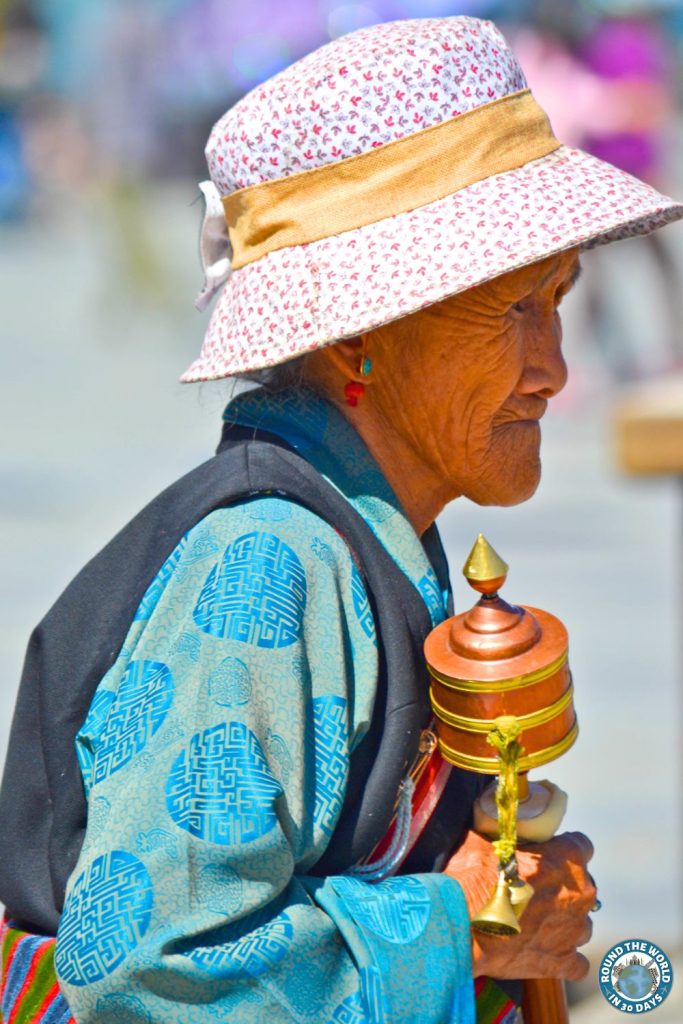
When we arrive, Tenzin points out the scores of local Tibetans who are out for their morning prayer walk around the palace. They walk in a clockwise direction, many spinning their prayer wheels and repeating Buddhist mantras.
According to the lineage texts, prayer wheels are used to accumulate wisdom and merit (good karma) and to purify negativities (bad karma).

We watch them for a few minutes before beginning the slow climb up to the entrance to the palace.
Like most places we will visit today, no photos are allowed inside the palace. So while all of my photos are exterior shots, inside the palace is incredibly impressive, both in sheer size and in design.

There are actually two palaces within the Potala complex, a red and a white palace. Prior to 1959, the Potala Palace was home to the Dalai Lama in the winter months.
Jokhang Temple
When we finish our tour of the palace Tenzin suggests we take a rickshaw to our next stop, Jokhang Temple and Monastery.
Since the temple is only about a mile away, it’s easier to catch a rickshaw than to walk back to the car and park it again. And it certainly beats walking now that the sun’s unhindered rays are beginning to beat down on us.

Also built in the 7th century and more than 1,300 years old, the Jokhang Temple (Da Zhao Si) is the oldest wooden structure in Tibet.
Its name, Da Zhao Si, literally translates as the “holy monastery for worshiping the big Buddha statues” and it has a supreme position in Tibetan Buddhism. Many temples in Tibet belong to a certain sect of Buddhism but the Jokhang Temple is respected by all sects.
Again, no photos are allowed inside the monastery.
But there are several open courtyard areas on the upper levels perfect for photographing Barkhor Square below and the Potala Palace in the distance.

Since Jokhang is considered the spiritual center of Lhasa, there are even more local people circling it while spinning their prayer wheels.
The course around the temple is marked by four large stone incense burners and it’s fascinating to watch the local pilgrims circle the temple lost in their mantras.
After leaving Jokhang, I stop for a little shopping in the nearby Barkhor market on my own (totally unsupervised!) and then re-join Tenzin at a local restaurant for lunch.

Norbulingka – Summer Palace
For our final stop, we hop back in the SUV and make the short drive out to the Summer Palace (Norbulingka).
Norbulingka means “treasure garden” in Tibetan and I can’t think of a better name for this beautiful place.

Tenzin laughs as I marvel at all the flowers and says, “It doesn’t look anything like this in the winter.”
Originally built in the 1840’s, Norbulingka has 374 rooms including a separate residence built for the current Dalai Lama (#14) in 1956.
It was only used for three years before the Dalai Lama’s exile to India in 1959. As we walk through the Dalai Lama’s former residence, Tenzin points out the different rooms where he studied, slept, and met with foreign leaders.
By mid-afternoon our tour is complete and we head back to the oasis of the St. Regis.

I’m a little tired but feel like I’m holding up fairly well with the thin air situation. I freely admit that I don’t feel terrific, but I don’t feel awful either. I think if I had one more day to adjust I would be good as new.
Tenzin, obviously impressed with my supreme athletic ability (ha!), comments that most of his guests want to go back to the hotel to rest after just the Potala Palace.
That makes me feel a little better.
That night I take it easy and get a good night’s sleep in my lovely suite.
In the morning, Tenzin returns to pick me up for my transfer back to the airport. It’s been a brief stay in Tibet but I’m so grateful that I was able to sort out the details to go.
It’s such a unique and beautiful region of the Himalayas and this trip wouldn’t have been complete without it.
How to visit Tibet legally
As you may have guessed, Tibet can be a complicated place to visit.
Of course, it’s easier now than it was even a few years ago. But there are still a few hoops to jump through if you plan to visit this sky-high Himalayan destination.
Here are three things you need to know if you’re planning a visit to Tibet:
1. You need a Chinese visa (first)
If you intend to visit Tibet, your visa application is probably not the time or place to mention it. If you indicate that you’re planning to visit Tibet while in China, your visa application will likely be denied.
I’m not saying you should lie, I’m just saying you might want to decide to visit Tibet after you apply for your Chinese visa.
2. You need a Tibet Travel Permit (TTP)
The TTP must be requested on your behalf by an authorized travel agency within Tibet and it will only be requested as part of a package tour to the region.
It is not possible to apply for the permit on your own which means that even independent travelers like myself need to book through a travel agency.
The other key part of the Tibetan Travel Permit is that (at the time of my visit) it had to be requested at least 15 days prior to your arrival in Tibet.
This is where I got into trouble.
A delay in response from the hotel’s in-house travel agency put me within the 15-day window making it virtually impossible to obtain the permit in time.
Luckily, this is no longer a strict requirement. And in my case, Tibet Vista was able to make it happen.
3. You MUST have a licensed guide
And that guide must be with you nearly all times while you’re outside of your hotel.
You also must have a car and driver from the minute you land until the minute you leave. The only place you’re technically allowed to be on your own is inside your hotel, though this is generally not strictly enforced within Lhasa.
The agency that requests your entry permit will make all of your arrangements within Tibet, including your driver and guide.
While the permit itself costs just a few dollars, the travel agency that applies for your permit is basically taking on sole responsibility for whatever you do while in Tibet.
That means if you take pictures of military activity or police, they can lose their license.
You should also be aware that your guide has the ultimate authority to have you removed from Tibet immediately (with no refunds) if you break the rules.
My guide, Tenzin, assured me that this rarely happens.
But when you arrive, you’ll hand over your entry permit to your guide and they hold on to it from then on. That means they control your ability to remain in Tibet.
When in Tibet, take everything your guide tells you as law. It is.

The easiest way to visit? Book a tour.
Tibet is not an easy place for the solo adventurous traveler. By far, the most hassle-free way to visit is to book a package tour with a reputable local agency.
This 4 days Lhasa tour is a great option if you’re short on time, like I was.
And while my short 3-day visit only included Lhasa, there’s much more to see in Tibet.
In fact, most visitors come for the easy access to Mount Everest Base Camp which is drivable in an SUV.
Yes, you read that right, drivable.
No need to make that pesky, death-defying climb from the Nepal side, just fly into Lhasa and in a few days you’ll be posing for that Mount Everest photo op courtesy of a Toyota Land Cruiser.
Here are a few of the best tour options for Lhasa and Mount Everest (offered by the company I used):
- 8 Days Lhasa to Everest Base Camp Small Group Tour
- 7 Days Lhasa to Kathmandu Overland Small Group Tour
- 4 Days Lhasa Impression Small Group Tour
And finally, none of this comes cheap.
When I first started looking into my permit, I already had my hotel taken care of thanks to a generous invitation by the St. Regis Lhasa.
All I really needed was airport transportation, the entry permit, and a full-day tour of Lhasa.
After a little research, I was initially shocked at just how much that would cost. Luckily, after digging a littler deeper, I found Tibet Vista. They were able to provide what I needed for a more reasonable rate.
The company was terrific in the pre-planning stages, in the delivery of my permit at the Kunming airport, and in the selection of my guide, Tenzin, who was fantastic.
But most people don’t go to Tibet just for a few days, like I did. And the prices have come down a bit in recent years. Prices are also much better for longer trips.
So yes, it is possible to visit Tibet legally. And currently, it’s easier than ever.
If you want to visit the “Roof of the World” start planning your trip now, there’s never been a better time to go.
And don’t let the cost deter you, this is one destination that’s worth the price of admission.
If Tibet isn’t on your Travel Bucket List, it should be.
Read More: I’ve Been to 175 Countries. Here are the 50 Best Places to See in Your Lifetime.
Looking for more great destinations in the Himalayas? Start here:
Himalayan Happiness in the Kingdom of Bhutan
More Than Just the Gateway to Everest, Kathmandu is It’s Own Adventure
Disclosure: Accommodation provided by the St. Regis Lhasa Resort.